

If you love tigers and pencil art, you’re in the right place! In this article, I’ll take you through my collection of my eight tiger drawings, each with a story behind it.
You’ll discover how I captured their personalities and expressions, my techniques for creating detail and depth, and even the challenges I faced along the way.
Whether you’re an artist looking for inspiration or simply a fan of wildlife, you’ll get a closer look at how these drawings came to life.
No more intro let’s just look at the art.
“Tiger in The Grass”
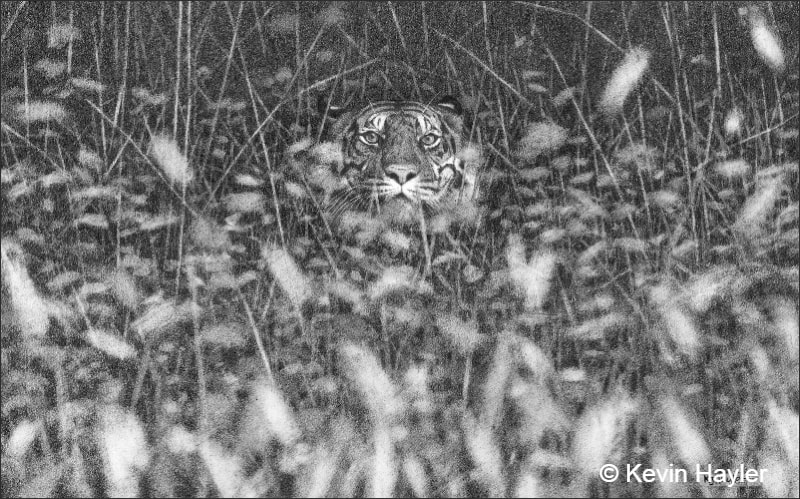
This ‘Tiger in the Grass’ print was one of my most popular when I first released it. It became a consistent bestseller and was one of my ‘bread and butter’ prints for many years. The pencil drawing features a Sumatran tiger that I originally photographed at London Zoo.
The setting is completely constructed. I wanted it to look like the tiger was in the wild and emerging emerging from tall grasses.
I used soft-focus effects using a putty eraser to create a bokeh impression, blending detail with an out-of-focus foreground to evoke the atmosphere and lend it authenticity.
Interestingly, this print sold very well in person, where people connected with the tiger’s intense gaze and the feeling of concealment. However, it didn’t sell as well online. It just didn’t have the same impact on screen as it did in real life.
“Cool Waters”

This is my pencil drawing called “Cool Waters,” based on a white tiger I photographed at the Singapore Zoo.
I focused on capturing the calm, determined expression as the tiger moved through the water, balancing the shimmering reflections with the bold contrast of its white fur against its dark surroundings.
The layout of “Cool Waters” was carefully composed to guide the viewer’s eye naturally across the scene. I simplified the reflections in the water to avoid unnecessary distractions, focusing on clarity and balance.
You will notice how the flow of the drawing moves in a subtle zig-zag. It starts from the top left with the tip of the tail and winds down in a arc to the tiger’s head, and leads downward through the reflections and ripples toward the bottom right.
This creates a visually pleasing path, adding harmony and direction to the overall piece without overwhelming the central subject.
As a side note, white tigers are not a separate species but are the result of a rare genetic mutation caused by inbreeding within a limited gene pool. They are undeniably striking but exist only in captivity due to these genetic anomalies.
“Tiger Rising”

This drawing is a close-up portrait of the same Sumatran tiger from “Tiger in the Grass,” but with a much tighter focus on the tiger’s face and expression.
The intense gaze, framed by soft fur textures and subtle shadows, gives the tiger an authoritative, almost regal look. I concentrated heavily on the eyes, ensuring they command your attention and convey both strength and awareness.
This piece was also a turning point for me. It was one of the first drawings where I used a 0.3mm mechanical pencil.
The level of precision it allowed completely changed how I approached details, especially in capturing fine fur strands and subtle shifts in tone. The result was a new level of clarity and sharpness that felt like a breakthrough in my work.
“Daybreak”
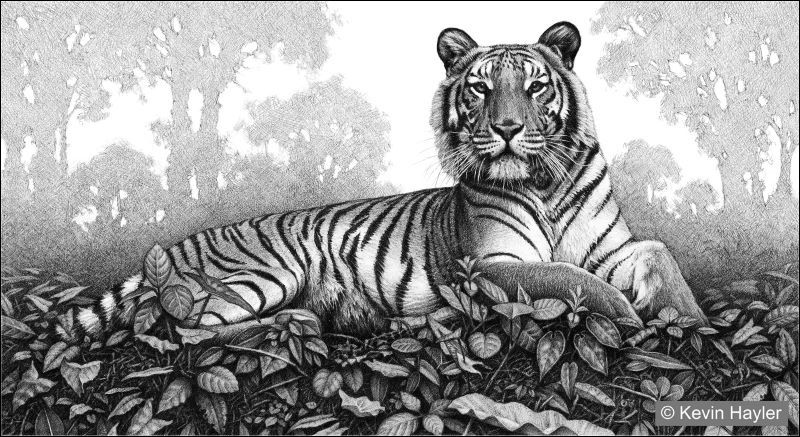
In this drawing, I’ve depicted ‘Phet’ reclining on a bed of foliage, surrounded by lush jungle vegetation. The tiger’s pose is relaxed yet commanding, with a calm, steady gaze that meets the viewer directly.
She was penned in a large natural enclosure near Kuang Si Waterfalls, a well-known beauty spot near Luang Prabang, Laos.
The composition contrasts the tiger’s bold stripes with the softer textures of the surrounding leaves. The trees are an improvised addition.
I kept the background lightly sketched, using silhouetted trees to create depth while ensuring the focus remained on her alone.
Her story is bittersweet. Phet was rescued as a cub after poachers killed her mother. Tragically, poaching later wiped out every wild tiger in Laos, leaving her as one of the last of her kind, a heartbreaking reminder of what we’ve lost.
“River Crossing”

‘River Crossing’ worked well as a drawing, but there were a few lessons learned the hard way. One challenge was the dimensions, it’s not a standard size. Be warned, customers are often put off by the cost of custom framing.
Trust me, losing sales over something avoidable is frustrating. I was too pig-headed to change. It cost me.
The black background was another challenge. I built it up in layers using a 0.3mm mechanical pencil.
I used a 0.3mm mechanical pencil, champhered to draw a ‘blunt’ line. I drew parallel diagonal lines in one direction over the whole area, using a ‘B’ grade lead.
Then I reversed the direction and went back across the page. I did this several times to build the value. I used a ‘2B’ to finish things off.
Drawing a dark background in layers avoided pencil shine and retained the grainy effect of the paper. Boy do you need patience for this type of drawing.
“Nightshift”

This was my first drawing of ‘Phet,’ the tigress. I decided to black out the background using the same layering technique I described before. I was hoping it would add drama to the piece.
While it works to some extent, I was never fully satisfied with the composition. In hindsight, it would have been better to draw her head as a study with a looser background.
The drawing sold out eventually, but slowly. Most viewers expressed a desire to see her face clearly.
That valuable feedback only came about from listening to people discuss my work. This is one of the great advantages of selling art in a market. It wouldn’t be easy to gain honest insights if I sold art exclusively online.
I took notes which ultimately led to the second version I called ‘Daybreak.’ (See Above).
“Rough and Tumble”

This pencil drawing captures a tense and dramatic moment between two tigers, their mouths are wide open in what seems to be an aggressive confrontation. The energy is palpable, fur standing on end, whiskers splayed, and teeth exposed.
Appearences can be desceptive. This is not so much ‘rough and tumble as it is ‘hanky-panky’ – tiger-style. The female is in season and the male is over-frisky.
The background is loosely textured and deliberately rough, adding to the drama without distracting from the action. The contrast between the bold tigers and the soft-edged background heightens the intensity and adds more movement.
“Eye to Eye”

This pencil drawing captures a wild tigress I observed in Kanha National Park, India. She peers out from behind a thick cluster of bamboo, her steady gaze locking onto the viewer with quiet intensity.
I wanted to emphasize the contrast between the soft texture of her fur and the hard, vertical bamboo stalks framing her face.
Although the bamboo was real, I rearranged and simplified it to enhance the composition. Carefully overlapping stems and leaves gave balance to the scene without overwhelming the tigress.
The interplay between the rigid bamboo and the tigress’s calm yet commanding presence creates a sense of tension and intrigue.
It was a rare privilege to be so close to a wild tiger. Her steady gaze was not aggression, but rather quiet curiosity, an unforgettable moment that I was fortunate enough to experience many times on subsequent visits.
8 Realistic Tiger Drawings: Final Thoughts
Tigers are truly iconic, symbols of strength and beauty that resonate with people across the world. There’s something universal about their appeal; the combination of power, grace, and mystery draws us in.
Creating these drawings allowed me to capture a small part of their essence, preserving moments that left a lasting impression on me. I hope they inspire you too, whether you’re an artist or simply a fan of wildlife.
Tigers deserve our admiration and protection, and I’m pleased to share these moments with you.
If you enjoyed this post you will like these too:
- 12 Wildlife Art Bestsellers (Use These Subjects to Make Money)
- 25 Realistic Animal Drawings
- 21 Realistic Big Cat Drawings
- How to Start Drawing Wildlife and Become a Wildlife Artist
- 6 Realistic Elephant Drawings in Pencil
- 12 Best Monkey Art Pencil Drawings
- 7 Bird Art Bestsellers: Best Wall Art Selling Guide
- 9 Farm Animal Art Bestsellers: Home Decor That Sells!
- How to Draw Realistically: 11 Realistic Drawing Tips
- How to Draw a Realistic Giraffe: Step by Step and Get Great Results
If You Want My Lifestyle, This is How I did it

PIN THIS


Hi, I’m Kevin Hayler
I’ve been selling my wildlife art and traveling the world for over 20 years, and if that sounds too good to be true, I’ve done it all without social media, art school, or galleries!
I can show you how to do it. You’ll find a wealth of info on my site, about selling art, drawing tips, lifestyle, reviews, travel, my portfolio, and more. Enjoy