

It’s hard enough making the work, let alone talking about it.
In this post, I’ll share my first-hand experience and teach you how to talk about your art in any type of art show.
I’ve sold my art from a market stall for over 20 years. and I’ve learnt a thing or two.
These are practical tips that will help you feel at ease and connect with people in a way that feels natural and lead to sales. That’s the bottom line right?
Disclaimer: When you buy something via my affiliate links I earn from qualifying purchases and sometimes earn a commission, at no extra cost to you. I am an Amazon Associate among others. I only recommend trusted sites.
Why Talking About Your Art Feels So Awkward
For a lot of us, it comes down to confidence. We are already battling a bit of imposter syndrome, so when it comes to explaining our work, it can feel like we are about to be caught out. Like someone might notice we are just making it up as we go along.
The awkwardness creeps in quickly. You start second-guessing yourself, unsure of what to say, and worried it might come out all wrong.
Part of the problem is that we put pressure on ourselves. We think we have to explain everything perfectly, or sound insightful, or say something that justifies the piece. And if we can’t, we start doubting ourselves.
Maybe the work is not good enough. Maybe we are not good enough.
And then there is the fear of sounding pretentious. No one wants to be that artist, the one who talks in riddles or tries to sound deep and mysterious. It doesn’t work.
Most people are not looking for a big explanation anyway. They just want a glimpse into your thinking. A little connection. Something real.
And you can give them that, without trying too hard.
Keep It Simple and Honest
The best thing you can do is stop trying to sound clever. You do not need to impress anyone. You are not writing a gallery brochure, you are just talking about something you made.
Start with the basics. What drew you to the subject? What was going through your head while you were working on it? Or in my case, it’s often where I was in the world. That is often enough.
You don’t need a deeper meaning if there wasn’t one. And if there was, you do not have to explain every detail.
Most people are not expecting a speech. They are just curious. If you say something simple like, “I just really love drawing textures, and this one gave me a chance to play with that,” it comes across far better than trying to make it sound more profound than it is.
You can always say more if someone’s genuinely interested. But there is nothing wrong with keeping it short and letting the art do most of the talking. Just say what you were thinking, or what you liked about making it, and leave it at that.
That honesty goes a long way. It is human. It makes people feel comfortable, and more often than not, they will appreciate the piece more because of it.

‘Push and Shove’
‘You don’t have to go all the way to Antarctica to get up close to wild penguins. All you need to do is hop on a local train in Capetown, get off in Simonstown and walk down to Boulders Beach. There are penguins everywhere, like these two’
Easy Prompts to Get You Talking
If you struggle to explain your work, having a few go-to prompts can make all the difference. You don’t need a script, just a few simple ways to get the ball rolling.
Start with something like:
- “I made this because…”
- “This reminded me of…”
- “I was drawn to the light in this one…”
- “I wanted to capture a certain feeling…”
- “I drew this scene when I was in…”
You don’t have to finish the sentence in a clever way. Just say what’s true for you. Maybe it reminded you of somewhere you’ve been. Maybe it was a technical challenge. Maybe it just made you smile. That’s enough.
The point is to ease into it. Once you get going, you’ll usually find you have more to say than you thought. And if not, that’s fine too. A short, honest comment is way better than freezing up or fumbling through something you don’t believe.
Think of these prompts like a warm-up. They’re not polished lines, they’re just a way to get the conversation started.
And don’t forget it’s a conversation so you can ask questions back, in fact you should.
It’s not a battle, it’s an exchange. If you show interest in the browser you’ll find common ground and that’s your connection.
That’s all you really need to move forward.
Let Your Captions and Titles Start the Conversation
One of the easiest ways to get people talking about your work is to plant the seed yourself. A good title or caption does that for you. It gives people a starting point, a little nudge that invites them in without needing you to say anything at all.
You don’t have to try too hard. Just add a small detail, a bit of personality, or a line that hints at the story behind the piece. If it makes someone smile, even better. It doesn’t need to be clever or poetic, just something real.
For example, here’s the caption I wrote for a drawing called “Sitting Pretty”:
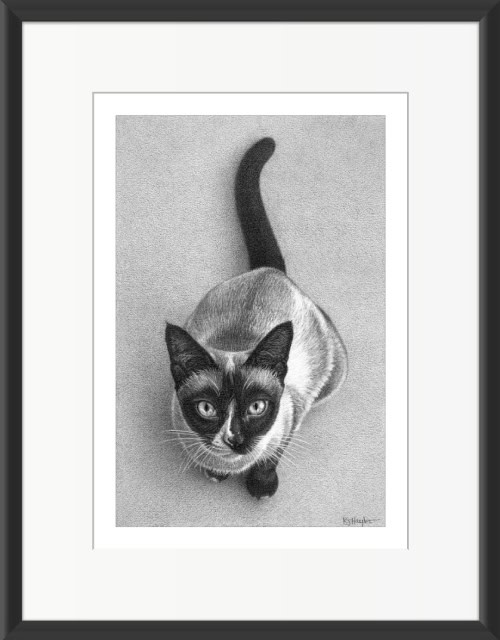
“This is a real Siamese cat, not a pure bred but Siamese none the less. I met her in Thailand and you can’t get more authentic than that, she’s a native. I was staying in a beachside guest house and this was the owners’ cat. Here she’s doing what all respectable cats do, waiting for her fair share of MY dinner. It’s not obvious from this angle but she was heavily pregnant and so emotionally, she had me over a barrel. I gave generously.”
It’s not trying to impress anyone, but it tells a little story. It’s warm, it’s specific, and it gives people a reason to pause and look again. That’s the point. You’re not explaining everything, you’re just opening the door.
If you sell face-to-face, it’s a great way to break the ice. And if you’re online, a simple caption like that gives people something to connect with. You don’t need to overthink it. Just say what happened, or what drew you to it, and you’ll find the words often land better than anything polished.
Read this: How to Name Your Artwork
Ditch the Art Jargon
If there is one thing that makes you sound like you are pretending, it is art speak. You know the stuff. Exploring themes, challenging perceptions, a visual dialogue between viewer and subject. It’s the kind of language that shows up in galleries and art school critiques, but out in the real world…
…it just puts people off.
It doesn’t make your work sound more important. It just makes it hard to understand.
The truth is, most people don’t talk like that, and they don’t want to hear it either.
They want to know why you chose that subject, what you liked about it, or what made it worth drawing. That’s it. No mystery required.
If you wouldn’t say it to a friend, don’t say it to a customer.
Now and then you’ll meet someone who does speak that way, and that’s fine. Let them. You can mirror to some extent, that’s how you build rapport, but most of the time, plain English works best. It’s clearer, more honest, and much easier to connect with.
Say what you mean, and say it simply. It’s far more powerful than any buzzword.
What Buyers Really Want to Know
When someone shows interest in your work, you do not need to tell them everything. Just give them a snippet. A little background, something personal, but not too much. You are not trying to impress them, just sharing a bit of the story behind the piece.
If they respond, great. Then you can expand. If they do not, just switch tack. Ask a question instead. Something open ended like, Do you paint yourself? Have you got a favourite artist? What kind of art do you like? That takes the pressure off and gives them space to talk about what they are interested in.
This Will Help: How to Build Trust With Customers and Sell More Art
You will often find a connection that way. And if you do, the conversation feels natural, not forced. You are not giving a pitch, you are just having a chat.
Another thing worth mentioning is framing. People often worry about whether something will fit their wall or match their space. Give them a sense of size and proportion in everyday terms.
Say if it fits in a standard frame, or how it might look above a sofa or on a small hallway wall. That helps them imagine it in their home, which makes a sale much more likely.
This is directly related: What Size Art Sells Best? Frames and Apertures – FREE Chart
It is these little details, framing, where it might hang, what drew you to it, that help people picture it as theirs. And once they do that, they are already halfway to buying it.

‘Fingers and Thumbs’
‘You can’t get much cuter than a baby chimp can you? They instantly pull the heart strings. I saw this toddler in a Chimpanzee Sanctuary established by the Jane Goodall Institute. It provides a refuge for abused and orphaned chimps. It’s situated in the Ol Pejeta Conservancy in Kenya. They aren’t wild, but have a huge fenced area within the reserve where they can lead a semi-wild life in safety.’
Practice Makes You Braver
Like anything else, the more you do it, the easier it gets. Talking about your work always feels a bit awkward at first, especially if you’re not used to it. But with a bit of practice, it starts to feel more natural.
You’ll find yourself telling the same stories over and over, and that’s a good thing. Over time, those stories settle into something familiar, like a favourite anecdote you know how to tell well. You edit it as you go, shave off the rough bits, add in the parts that seem to land.
Eventually, you just know what to say and when to say it.
That only comes from practice. You can’t fake it, and you can’t learn it any other way. You’ve got to talk to real people, stumble through it a few times, and gradually figure out what works.
It just has to sound like you, and once you’ve done it enough, it becomes second nature, like a ‘muscle’ memory.
Quick Lines That Break the Ice
Sometimes a bit of silliness does the job better than anything else. Having a few light one liners or gentle jokes up your sleeve can really help.
I have picked up a few over the years. One of my favourites is when a family stops and a youngster comes over to watch me draw. They often ask, “How do you do that?” and I reply, “Have you ever met a genius before?” When they say no, and I put my hand out and say, “How do you do?”
It’s daft, but it gets a smile all round.
Little moments like that are worth more than you would think. People remember how you made them feel, not just what you said. And if you can get someone to laugh or relax, it opens the door for a proper chat. Not just about the art, but about anything really.
These moments come naturally over time.
They become part of your rhythm. They take the pressure off and make the whole experience more enjoyable for everyone.
How to Talk About Your Art: Final Thoughts
You don’t have to be a confident speaker to talk about your art, your confidence comes with practice. You just need a few honest words and a bit of practice. I’m naturally very shy, but I appear confident to anyone meeting me for the first time – I’m secure in this context.
The secret is to start small, keep it simple, and let your personality do the work. If you can share a bit of your story, make someone smile, or help them picture your work in their home, you are already doing more than enough.
No one likes a pushy salesy or pretentious artist so if you’re shy, you have a built-in advantage. Believe me.
Just be you. People will respond.
The more you do it, the easier it gets. And before long, you will wonder why you ever worried.
Did This interest you? Do you need more help? If you need a shortcut read this:

Read these posts for more about selling art:
- Pricing Art For Beginners: Originals, Art Prints, and Formulas
- What Kind of Art Sells Best? All The Secrets Revealed
- You Must Find an Art Niche: How and Why
- Artist Business Cards: 6 Tips For Artists – From a Pro
- How to Negotiate the Price of Your Art: Prints and Originals
- Can You Copy Art and Sell a Painting of a Painting? I Found Out
- How to Prepare For an Outdoor Art Fair: Tips for Success
PIN THIS


Hi, I’m Kevin Hayler
I’ve been selling my wildlife art and traveling the world for over 20 years, and if that sounds too good to be true, I’ve done it all without social media, art school, or galleries!
I can show you how to do it. You’ll find a wealth of info on my site, about selling art, drawing tips, lifestyle, reviews, travel, my portfolio, and more. Enjoy