

Smudging is a pain. You think the drawing looks fine, then you notice a dirty patch where your hand has dragged across the paper. It happens before you realise.
You can avoid most of it with a few simple habits.
In this short guide I’ll show you how to keep your bad habits under control so your drawing stays clean.
Disclaimer: When you buy something via my affiliate links I earn from qualifying purchases and sometimes earn a commission, at no extra cost to you. I am an Amazon Associate among others. I only recommend trusted sites.
Draw In a Logical Direction
Work in a way that keeps your hand away from finished areas. It sounds obvious, but most smudging comes from bad positioning, not the materials.
If you’re right-handed, start at the top left and move across and down. Left-handers do the opposite.
Keep the habit consistent. Once you get used to planning the drawing in one direction, your hand has far fewer chances to drag over fresh graphite.
Put a Barrier Between the Paper and Your Drawing Hand
The classic way to stop smudging is to place a clean sheet under your hand while you draw. It keeps your skin off the graphite and gives you a smooth surface to rest on.
Use plain smooth paper. Photocopy paper works. Wax paper and tracing paper work too. Avoid anything creased or textured because it drags and makes things worse.
The paper only helps if it stays still. If it moves around, you rub the paper across the surface and lift graphite. That defeats the point. Keep it steady.
Check the underside now and again. If you see graphite building up, change it for a clean sheet. It is not perfect, but it works well enough when you stay on top of it.
Hold the guard in place with your free hand. Keep your movements controlled. If you want it locked down, secure the edges with low tack acid free tape.
When I work on a flat surface or a low angle, I sometimes rest my left hand on the page and keep it fixed. Then I rest my drawing hand on top. It gives me support without letting my drawing hand touch the paper. It is a simple habit that keeps the surface clean.
Use the Cellophane Trick
I don’t know anyone else who does this, but it works. I place a sheet of cellophane over the drawing when I need extra protection. It creates a smooth barrier that seldom picks up graphite.
Use a clear polypropolyne sheet that comes in a roll or I use cellphane wrappers, the self-seal bags you can by to display prints. They’re very cheap.

If you work outside you must take extra care
I tape the film over the drawing so its firmy in place, and tear a hole where I plan to work. In other words the whole surface is covered accept the area I intend to work on.
I work outside and naturally it protects the paper, but its useful at home too. Even sipping a coffee has it’s hazards.
The main advantage is simple. You can see what your work through the cellophane and it keeps the surface clean while your hand moves freely.
There is a caveate to my cunning method. At times, when you work outside, you’ll get a tiny insect manage to get inside the wrapper. Be careful you don’t squish it.
One more while I think of it. I use my drawing skills at my market stall to attract people to come and see what i’m doing. I know from experience that people almost instinctively try touching the work.
You would never guess that is an occupational hazard unless it happened to you, and believe me it’s real. The cellophane stopped me from freaking out.
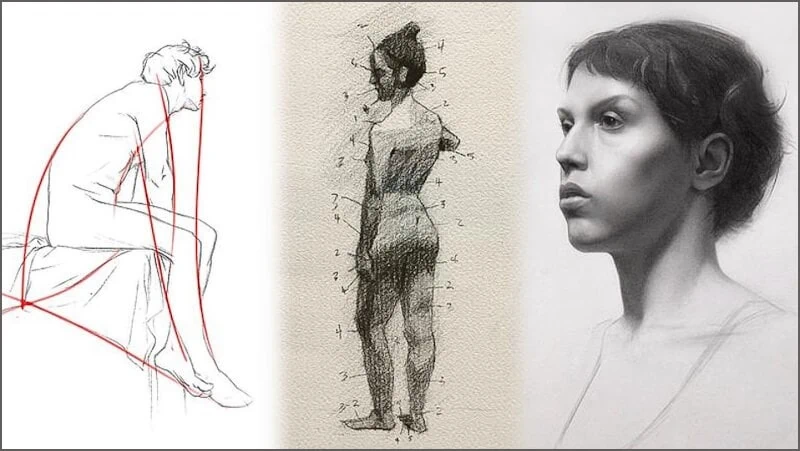
If you need more help with drawing, then I urge you to check out
Dorian Iten on Proko. His course is reasonably priced and inspiring
Use a Mahl Stick at an Easel
A mahl stick ( a rod) is another way to keep your hand off the paper. Painters use them all the time and they work just as well for drawing.
You rest the tip on the edge of your board and balance your drawing hand on the stick. It gives you steady control without touching the surface. It also helps when you need to hover over wet or fragile areas.
Use a light grip. Let the stick take the weight of your hand so you don’t press into the paper. It feels odd at first, but once you get used to it the movement becomes natural.
They are cheap and easy to make. A smooth dowel with a rubber tip (ferrul), hooded with a piece of fabric, is all you need. It’s worth trying if you want a firm rest that never risks smudging your work.
Keep Everything Clean
Being aware of likely problems and getting into the habit of checking for problems is the way to keep your drawing clean and tidy.
These are the things you should look out for:
- Smudging is worse with the softer B pencils, so take extra care when you use them.
- Check the side of your hand often. If it looks dirty, clean it before you carry on.
- Keep an eye on the white areas in your drawing. Smudges are not always obvious until you erase a ‘clean’ patch and see how grey the paper has become.
- Make sure your eraser is clean. Hard erasers can leave marks you can’t remove. A kneadable eraser is safer, but even they get too dirty in the end and need replacing.
- Be careful when removing eraser crumbs. Blowing them away can leave moisture on the page, which is a problem if you’ve just had a coffee!.
- Use a clean feather-head brush to lift crumbs. Or hold the board upright and tap it so the debris drops away without touching the surface.
One final tip that you will find handy.
Sometimes you will lose the ‘zing’ in your work. The tonal range flattens and you realize to your horror that the whole drawing is now grey and the whites have vanished.
What do you do when the your precious highlights are lost? How on earth do you recover the sparkle in an eye for instance?
Get a battery eraser.
They are a game-changer for saving your work. You can get very cheap ones online and they are the only way to guarantee that you get those tiny white areas back.
Putty erasers are good, battery erasers are far better.

This battery eraser changed the game for me
Smudging Pencil: Final Thoughts
Keeping your work clean is mostly about building good habits and repeating them until they feel automatic. Once you train your hands to move a certain way, the muscle memory takes over.
Obviously its better to prevent problems in the first place, but none of us are that perfect. That’s why checking the work regularly is key. Its far easier to correct minor problems as you go along rather than having to rescue a ‘finished’ drawing at the end.
If you love to draw and want to know how I made a good living selling my work for over 20 years, my guide Selling Art Made Simple will interest you.
I cover the methods I used to sell wildlife art from a market stall and how you can take the same approach and make it work for your own style.

If you found this advice helpful you check these out too:
- Is It Cheating to Trace Your Art? Is It Really Ok?
- Can You Draw With Mechanical Pencils? Folly or Game-Changer?
- The Basic Skills of Drawing: Learn to Draw For Beginners
- How to Know When Your Drawing is Finished: Don’t Ruin it!
- Can You Copy Art and Sell a Painting of a Painting? I Found Out
- What Do Pencil Numbers Mean? Pencil Shades Explained
- Is Drawing From Photos Bad? Are You Cheating?
- How Do You Get White Lines in a Pencil Drawing? (Without Going Mad)
- 9 Ways to Stop Pencil Shine in a Drawing and Save Your Work!
PIN THIS


Hi, I’m Kevin Hayler
I’ve been selling my wildlife art and traveling the world for over 20 years, and if that sounds too good to be true, I’ve done it all without social media, art school, or galleries!
I can show you how to do it. You’ll find a wealth of info on my site, about selling art, drawing tips, lifestyle, reviews, travel, my portfolio, and more. Enjoy