

Most of the drawing tutorials you’ll find online are filled with cartoonish sketches by people who really haven’t mastered their craft. In this guide, I’ll walk you through how to create a lifelike baby elephant my way, using nothing more than a few pencil grades.
I’m going to take you through my process. It’s the same drawing method I use for nearly all my wildlife art. You’ll see there’s a lot more involved than you might expect.
Read on..
Disclaimer: When you buy something via my affiliate links I earn from qualifying purchases and sometimes earn a commission, at no extra cost to you. I am an Amazon Associate among others. I only recommend trusted sites.
The Elephant Drawing Begins
Step 1: Draw the Outline of Your Elephant

First things first, I photocopied my original photo and enlarged it to the size that looked comfortable to draw.. I drew a grid over the photocopy and drew another grid on my paper to the same scale.
Both must be accurate, so pay attention. Near enough, is not good enough
I use an HB Derwent Graphic pencil to draw things in. Sometimes I’ll stick to just outlining the subject, while at other times I’ll block in the darker areas with some rough shading.
The choice really depends on the reference photo I’m working from and how challenging I expect the drawing to be. In this case I did very little initial shading.
Step 2: Start Drawing the Eyes First

I always begin with the eyes because they bring the drawing to life. If the eyes are off, the rest of the sketch won’t matter; the whole piece will fall short.
In this case, the eyes are too small to be the focal point but the placement must be exact.
At this stage, I put aside my regular pencil and switch to a Pentel mechanical pencil for sharper detail.
I began with a 0.3mm B lead. Instead of pressing in the darkest tones right away, I built them gradually in layers. Working this way makes it much easier to erase softly applied shading than trying to correct one heavy, solid layer.
There is no sparkle in the eye to worry about, so as soon as I’m happy, I expand my shading around the eye and start to add in some surrounding detail.
Step 3 & 4: Expand Slowly and Add More Detail


I like to bounce off of success. As soon as I can see something emerge, I use that to boost my confidence. I can relax after I’ve made a good start and there’s no chance I’ll have to start again.
I work square by square. I use a combination of my photocopy, and my original photo reference, to guide me every step of the way.
Yes it’s methodical and not exactly fast and loose, but that’s how I draw such fine detail.
If you want to know how I see detail like this, it’s simple. I use a magnifying glass. Like the one below.

Step 5 & 6: Moving on to the Ear


I used a blunt tip to shade in the initial tones, and made sure to map in the folds in the ear. Once the base was correct I could add the speckling, which in real life was dried crusty mud.
This was far easier than it looks. I shaded the ear, using the texture of the paper to retain a grainy effect and dotted the paper with a small piece of Blu-Tack. Super accuracy was not required.

Step 7 & 8: Drawing The Wrinkly Skin


I shaded the paper with a mid tone to fill the front leg. I needed to see the grid so it wasn’t dramatic. Although drawing every wrinkle wasn’t necessary, it was important to follow the direction and reproduce the patterns I could see.
There are lines and major folds that needed to look authentic. I mapped the dominant lines and used those as my guides to fill in the rest. Once I was happy with the general placement I could shade over the grid and lose it.
As always, I shaded the paper and lifted the texture with Blu-Tack or a kneadable eraser.
Steps 9,10,11,12: Repeat The Process in Each Square


You can see how methodical I can be. It’s pretty much a case of rinse and repeat. Here I’m working from left to right so I must be careful not to lean on the paper. It’s very easy to get lazy and smudge your paper without realizing it. That’s a big mistake.
Read this related post: How to Prevent Your Drawings From Smudging Everytime
Steps 13,14,15,16: Patience Required


Using a magnifying glass can lead to another mistake. When you focus intently on fine detail you lose the bigger picture. It’s essential to pull back every now and then, and look at the whole drawing.
If you’re not careful, you end up drawing each square perfectly, but they are not tonally aligned with each other. One patch will be lighter or darker than it should be. You lose coherence.
Pulling away allows you to see where the imbalance occurs, so you can correct it.
Sometimes your concentration is so intense that you are blinded by the minutiae. In that case, walk away and refresh yourself. When you return it will be easier to see glaring mistakes.
Steps 17,18,19,20: The Final Stages


When the subject is near completion, you must decide how much contextual background setting to include. Ideally you have already planned it out, but it’s not always that straightforward.
This was a wild elephant and I could’ve added the surrounding scrub. As it was, the purpose of this pose was to make the viewer smile. I didn’t want distractions.
A background wasn’t needed. I added some ground shadow and short grass to give it a firm base and balance. That was enough.
Stage 21: Tidying Up
The next step was to erase the gridlines. This is when you realize the importance of never pressing hard with your pencil. If you can’t rub out the lines, you’ll have to draw a background to cover your grid lines. I’ve done that a few times.
Be careful when you erase the paper. It’s easy to erase too hard and either buckle the paper, or leave a grease smear. Go easy and use a clean eraser.
Draw the final borderline very lightly and if you go wrong, you can erase it and start again.
Stage 22: The Result

After all that work you have a drawing ready to be professionally scanned and printed. I can’t recall how long this took, but typically I’ll spend a week on a very detailed drawing.
You’ll notice that the previous images are all drawn on ivory paper. I insisted on drawing on tinted paper for years. It took me a long time to come to my senses.
It’s much harder to create a good scan of black and white art on colored paper. You must either produce color prints, with the added costs and complications, or you must remove the color. Fine if you can do it yourself, not if you have to pay for editing.
You are very dependent on the skill of the guy adjusting your artwork. Things go wrong. Be warned.
This is related: How to Make Prints of Your Art: A Complete Printing Guide
If you draw with the intension of printing, do yourself a favor, and draw on white paper, not tinted.
These ivory scans were made at home, the final white image is a (reduced) professional scan.
How to Draw an Elephant: Final Thoughts
That’s it really. That’s the process. It’s slow and deliberate. You might say I’m risk-averse, but bear in mind that I work professionally, I must get results, I can’t afford to scrap work and start again.
Creatively, using a grid has real drawbacks. The happy accidents that usually occur and sometimes lead to a break through and ah-ha moments, are few and far between.
But, I do astonish people with my attention to detail and it’s become my signature style. My drawings bring pleasure to many people and that’s a good enough reason to draw this way.
If you need more help with drawing, then I urge you to check out
Dorian Iten on Proko. His course is reasonably priced and inspiring
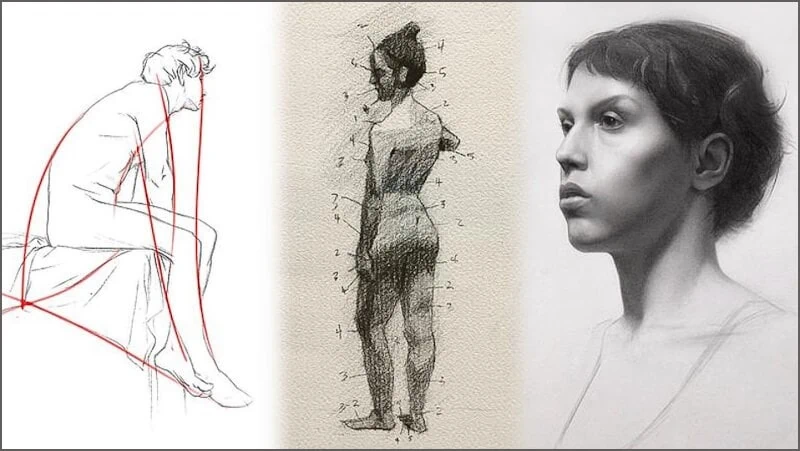
And check out these posts too:
- Drawing Ideas for Adults: 120 Cool and Easy Things to Draw
- How to Find Your Drawing Style: 8 Ways to Develop Your Skills
- How Do Wildlife Artists Make a Living? Copy This and Get Started
- How to Create Depth in Your Drawing: 7 Expert Techniques
- How to Trace a Drawing: 12 Ways to Get Results – Fast!
- How to Draw a Realistic Giraffe: Step by Step
- How to Repair Drawing Paper: 9 Ways to Rescue Your Artwork
- What’s The Right Paper for Pencil Drawing? (How to Choose Wisely)
- How to Scale Up a Drawing in 4 Easy Ways
- Is Drawing From Reference Photos Bad? Are You Cheating?
PIN THIS


Hi, I’m Kevin Hayler
I’ve been selling my wildlife art and traveling the world for over 20 years, and if that sounds too good to be true, I’ve done it all without social media, art school, or galleries!
I can show you how to do it. You’ll find a wealth of info on my site, about selling art, drawing tips, lifestyle, reviews, travel, my portfolio, and more. Enjoy