

Leaves are easy to draw. There’s nothing to be intimidated by. If you can sketch a few simple shapes, you can draw a leaf.
I’ll show you some of my drawings and explain how I did them. You’ll see the steps I take to draw convincing leaves and share the tips I use to get the best results.
Drawing leaves is good fun because if you obey a few basic ‘rules’ you can get great results with very little effort.
We’ll start with a detail from my drawing of a red fox.
Autumn Leaves Drawing and a Fox

This drawing comes from a photo I took of a fox. The leaves frame the scene, and I want to show you how I drew them.
Look closely at the way the veins work. They branch off the central stem symmetrically, and beyond that you don’t see any other veins. If you copy that structure in your drawing, the leaf looks natural. If you don’t, it feels wrong, even if the outline is good.
Now check the edge. These leaves have a very slight serration. It’s easy to miss, but if you leave the serrations out, the leaves won’t look authentic.

In wildlife art it matters to place the right foliage in the scene and draw it to scale. Those details make the difference between a drawing that feels real and one that looks guessed.
For the smooth shading, I use H grade pencils, mostly HB, 2H, and 4H. On paper with a slight tooth, the harder leads keep the tone clean without filling in the grain. Try them and you’ll see how much easier it is to get an even finish.

Before I move on, I’ll just point out the dead and dried leaves littering the woodland floor. They are crumpled and curved over and look distinctly different from the leaves on the tree stump. I fabricated much of this to add some interest.
I dragged a graphite stump across the paper to highlight the paper grain, then pressed a dab of Blu-Tack onto the paper to remove randon shapes. With a little imagination I could adjust the shapes and add shadows from the right direction. Simple really.
How to Draw Bamboo Leaves
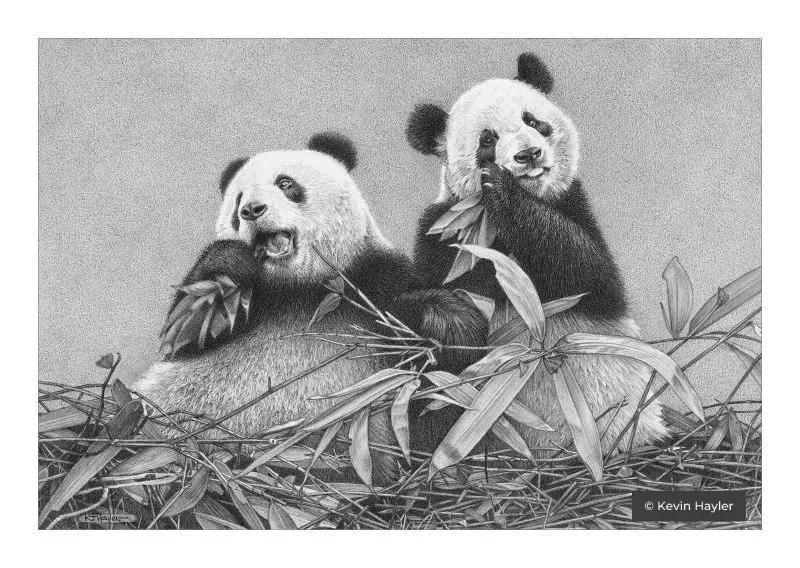
Now compare these leaves with the last example. The tree leaves around the fox were oval with serrated edges. These bamboo leaves are completely different. They are elongated, narrow, and pointed, and because bamboo is a giant grass, the structure is simple but bold.
Each leaf has a single strong ridge running down the center. From that ridge, you’ll see fine, parallel lines that run towards the tip. It’s important to follow the central ridge with your pencil strokes to simulate the leaf structure. That way you keep the leaf looking natural and flowing.
Look at the kinks in the leaves. Wherever a leaf bends, a shadow appears. If you study it closely, you’ll notice how the darker shadow sits just below the fold. Directly above it, where the leaf catches the light, you’ll see a highlight.
This shift from shadow to highlight is what makes the leaf look three-dimensional.

Always draw what you see and not what you know to be true. They are a mismatch. If you look at the leaves you’ll see none of them are perfect shapes. They have kinks, tears, and folds. It’s important. If you have to im provise this will help you to create very realistic foliage.
How to Draw Glossy Leaves

These are leathery evergreen tropical leaves, and they need a different approach. These are broader, heavier, and shiny. You can see straight away they have more substance.
Start by looking at the structure. Each leaf has a strong central vein with secondary veins branching out at angles, evenly spaced with deep ridges. What really defines these leaves is the surface. They’re thick and waxy, and that’s where the light plays an important role.
Notice the highlights. The shine is sharp and runs along the curves, especially near the tapered tips and folds. That glossy look is what makes them read as evergreen leaves. I suggested the texture by using firm shading and using higher contrast against the highlights.
Work with the shape and the way the leaf bends. TTake note of the direction of the light for consistance across the drawing. Note where the light catches on the raised surfaces and drops away into shadow. If you get that contrast right, the leaves will look tough and leathery, just as they are in real life.

How to Draw Random Leaves

The jungle floor is chaotic, and that’s what makes it interesting to draw. There’s a mix of shapes everywhere, from broad heart-shaped leaves to narrow pointed ones, all layered on top of each other. You don’t need to make sense of the tangle, you just need to capture the variety.
What gives it depth is the way the shadows fall. Some leaves are pushed forward by light, others sink back into shade. Cast shadows across the leaves are essential. They stop everything from looking artificial and they create the three-dimensional effect that pulls the scene together.
Look at the dark spaces. Some areas are completely blacked out, and a few leaves are barely noticeable. That contrast is what makes the drawing work. It’s not about showing every detail, it’s about suggesting enough and letting the shadows do the rest.

How to Draw Simple Leaves

Sometimes it helps to point out what I could have done better. It makes the lesson clearer. If you compare this drawing with the fox at the beginning, you’ll notice the difference. Both scenes feature coppiced sweet chestnut trees, but the leaves here are not as refined.
I drew this picture a few years before the fox, when I was still finding my way. The leaves are less defined. They work well enough, but looking back I can see they could have been drawn more convincingly, with stronger shadows and more depth.
The bulbous shapes between the veins aren’t developed properly. I only rendered them in a basic way, so they lack that 3-D, natural feel. It’s a reminder that your skills build over time. The more you study and practice, the more believable your drawings will become.

Tropical Tree Leaves

I was in 2 minds about including this one, only because I’ve never been happy with it, but as is often the case, the public liked it and it was one of my bestsellers back in the day.
It was drawn a very long time ago and I had a poor reference photo to work from and, if the truth be told, I forced the composition.
This baby orangutan was originally in Singapore Zoo and swinging on a metal bar. That was no good, so I replaced it with the tree branch and leaves.
I looked up genuine photos of wild orangutans and that gave me the information I needed to draw the same type of leaves and tree trunks you’d see in the wild. I wanted the type and size to be as authentic as possible.
To add some interest, I riddled the leaves with insect bites and holes, as you would see in real life, and then I added strong highlights to give them a natural 3-D look. I’m sill not happy but at least the leaves are fine.

Drawing Leaves: Final Thoughts
Leaves in nature are never the perfect shapes you see laid out flat. They are foreshortened, angled, twisted, bent, half eaten, and torn.
To draw them convincingly, you must gauge where the veins meet the central stem, copy the pattern you see, and take nothing for granted—especially the direction of the light.
If you want to improvise, try a simple trick. Draw a leaf, cut it out. Score a few side veins if you like. Now you can hold it at any angle, see how the shape changes, and judge how the light falls across the surface.

If this article gives you a few fresh ideas try these:
- How to Draw Realistic Shadows in Pencil: Light and Shade
- How to Draw Realistically: 11 Realistic Drawing Tips
- How to Draw a Realistic Giraffe: Step by Step and Get Great Results
- How to Draw Texture in Pencil: 7 Tips for Realistic Results
- Drawing Realistic Grass the Easy Way: For Beginners
- How to Draw White Lines in a Pencil Drawing: Do This…
- Is Hyperrealism Art or a Skill? What’s the Point?
- How to Draw Water in Pencil: Drawing Water Step by Step
PIN THIS


Hi, I’m Kevin Hayler
I’ve been selling my wildlife art and traveling the world for over 20 years, and if that sounds too good to be true, I’ve done it all without social media, art school, or galleries!
I can show you how to do it. You’ll find a wealth of info on my site, about selling art, drawing tips, lifestyle, reviews, travel, my portfolio, and more. Enjoy