

If you want to know how to get good at drawing, and already know the basics, adding personality will improve your art.
I draw animals from reference photos, and I’ve learned that a few small tweaks can turn a stiff illustration into something that actually feels alive.
In this guide, I’ll walk you through the drawing tricks I use to bring personality and character into every sketch. These are simple art techniques you can try today, no matter your skill level.
Disclaimer: When you buy something via my affiliate links I earn from qualifying purchases and sometimes earn a commission, at no extra cost to you. I am an Amazon Associate among others. I only recommend trusted sites.
Start With the Eyes to Add Character
The eyes are everything. Get them right, and the rest of the drawing follows. Get them wrong, and no amount of fixing will save it.
I always start here, I don’t wait until the end. If I leave the eyes until last, hoping it’ll all come together, it courts disaster. I want the eyes to look right before I commit my time and energy to the drawing.
The eyes set the drawing’s mood
Here’s the thing about eyes: they’re not just a shape you copy from a reference. They’re where your viewer makes contact. They’re where all the drawing personality lives.
Direct eye contact has the most impact. If your animal is looking straight at the viewer, it feels present, and aware. That’s way more powerful than eyes looking off to the side.

Small tweaks matter..If the eyes in your reference photo look a bit sleepy, open them up. Make them wide and alert. Are they looking the wrong way? Turn them toward the viewer.
Even tiny details count. The size of the pupils, the placement of a catchlight, a slight difference between the two eyes. All of it adds up to character.
Read This: How to Draw a Realistic Eye
This is one of those drawing tips that sounds small but changes everything. Nail the eyes, and you’ve already won half the battle.
Break the Symmetry to Add Action
A lot of beginner animal drawings end up too symmetrical. Both ears identical. Eyes mirrored exactly. The head centered dead straight.
That’s actually what makes them feel stiff. It ends up looking like a logo, not a living creature.
Real animals are never perfectly symmetrical, even when they’re standing still. The head tilts a touch. One ear turns slightly differently than the other. The weight rests a bit more on one side than the other.
So here’s one of the simplest drawing hacks you can use: break the mirror symmetry on purpose. Even if you’re drawing from imagination, add a small offset somewhere.
Tilt the head just slightly. Make one ear angle differently than the other. Shift the weight so it’s not dead center.
That small imperfection is exactly what your eye reads as alive. A perfectly even drawing looks like a diagram. A slightly uneven one looks like a moment.
This is an easy technique to test on your own work. Look at your next sketch. Is everything lined up too neatly? Try nudging one side, just a little, and see what it does to the whole piece.
Bringing Life Into a Still Reference
Photos freeze a moment. But animals are never really still, even when they look calm.
So when I work from a reference, I don’t just copy it. I look for the line of movement that’s already hiding in the pose, then I push it further.
Say an animal is caught mid-stride in a photo. Maybe its back curves just a little. I’ll stretch that curve more than the photo actually shows. Maybe one leg is slightly misplaced. I’ll move or exaggerate that angle a touch.
This isn’t about drawing studying and anatomy. It’s about noticing what’s already there and nudging it in a direction that looks better.
Stretch a curve a bit further. Tilt an angle a bit more. Compress one side of the body while you stretch the other. These small shifts take a static photo and turn it into something that feels like it’s mid-motion.
This is one of my favorite drawing tricks, because it’s simple. You’re not inventing a pose. You’re just turning up the volume on the one you already have.
Mix and Match From Multiple References
You don’t have to stick to one photo. Sometimes the best pose doesn’t exist in any single reference. You build it yourself.
Take this drawing of two penguins. In the original photos, they were standing together, but neither shot had quite the pose I wanted. So I cherry-picked the best parts from two different photos and combined them.
One penguin’s stance came from one photo. The other’s came from a second. Put together, they told a better story than either photo did alone.
I also changed the eyes. In the references, both penguins had half-closed eyes. That’s fine for a photo, but it doesn’t work for a drawing that needs presence. So I opened them wider, and the whole pair suddenly felt more alert and engaged.
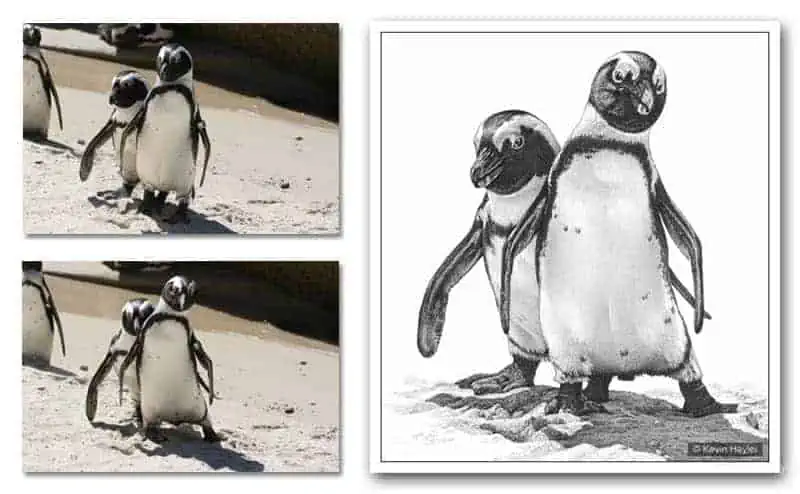
This is one of the best drawing ideas for animal subjects. You’re not limited to copying what’s in front of you. You’re building a new moment out of pieces that never actually happened together.
It takes a bit of confidence to move away from the reference like this. But it’s one of the most useful drawing hacks for adding personality, because you’re not just recording a photo. You’re directing a scene.
Next time you’ve got a few reference shots of the same animal, look for the best piece in each one. The best head angle here, the best paw position there. Combine them, and adjust anything that still feels flat, like sleepy eyes.
You’ll end up with a pose that’s better than any single photo you started with.
Useful Posts:
Let the Line Stay a Little Loose
Not every mark needs to be perfect. In fact, chasing perfection can work against you.
A line that’s too controlled, too careful, ends up looking traced. It loses the sense that a real hand made it.
Compare that to a slightly rougher mark. Maybe it overshoots a bit at the end. Maybe there’s a faint second line where you adjusted a curve mid-stroke. That kind of looseness reads as confidence, not carelessness.
Think about how you actually draw when you’re not overthinking it. Your hand moves quickly, and it doesn’t always land exactly where you meant it to. That small imprecision is what makes the mark feel human.

So resist the urge to clean everything up. If a line wobbles slightly, or a doubled stroke shows where you were feeling your way through a shape, leave it. Don’t erase it just because it isn’t tidy.
This is a strange one among all these drawing techniques, because it goes against instinct. Most of us want our lines neat. But a sketch that’s too polished can end up feeling stiff, the opposite of what you’re going for.
This Will Help : Drawing Movement: 7 Drawing Tips for Beginners
Try it on your next piece. Pick one area, maybe the edge of a wing or the outline of a leg, and let your hand move through it fast, without correcting. Don’t tidy it up afterward. See how much more alive it feels compared to the carefully drawn version next to it.
Let the Title Do Some of the Work
Character isn’t only built with a pencil. Sometimes it’s finished with a title.
The right title can nudge how someone reads a piece.
I drew a lion once with a proud, superior expression. I titled it “Head of the Family.” People saw a father figure in it, even though I never drew anything deliberately paternal. I just liked the pose.

But, that one title steered how the image felt, and it turned into one of my best-selling prints, especially as a gift for dads.
That’s the power of suggestion.
This works because people don’t just look at a picture, they look for meaning in it. Give them a title that hints at a story, a relationship, or a feeling, and they’ll find it in the drawing, even if you never consciously put it there.
This Post Reveals All: How to Name Your Artwork: Find a Title That Sells
It’s a small step, easy to overlook. But if you’ve spent all that effort adding character to a piece, don’t waste it with a flat, literal title like “Lion.” Give it a name that leans into the feeling you want people to walk away with.
Drawing Personality: Final Thoughts
Adding personality to a drawing isn’t about one big trick. It’s a handful of small choices, stacked together.
Start with the eyes. Get those right, and everything else follows. Look for movement hiding in your reference, and push it a little further than the photo shows. Don’t be afraid to mix and match the best parts from different photos if it tells a better story.
Exaggerate one feature instead of everything. Break the symmetry a little. Vary your line weight, or your pencil pressure, so the drawing has real physical presence. Let a few lines stay loose instead of perfect. And once the drawing’s done, think about the title. It can shape how people feel about the piece just as much as the linework does.
None of these are complicated. That’s really the point. If you’re wondering how to get good at drawing, you don’t need a complete overhaul of your process. You need a few deliberate tweaks, applied with intention.
Try one of these on your next sketch. Just one. See what it does to the finished piece. Then try another next time. Personality builds up gradually, one small decision at a time.
If you need more help with drawing, then I urge you to check out
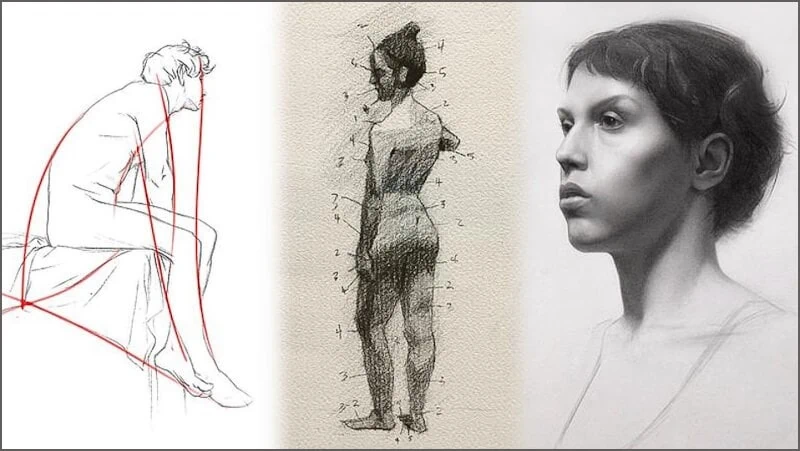
Dorian Iten on Proko. His course is reasonably priced and inspiring
Now Check Out Some These Related Articles:
- How to Find Your Drawing Style: 8 Ways to Develop Your Skills
- How to Draw Realistic Shadows in Pencil: Light and Shade
- How to Draw Realistically: 11 Realistic Drawing Tips
- How to Draw Water in Pencil: Drawing Water Step by Step
- How to Draw White Lines in a Pencil Drawing (Without Going Mad)
- How to Make Your Drawings Interesting: 14 Ways to Improve a Drawing
PIN THIS


Hi, I’m Kevin Hayler
I’ve been selling my wildlife art and traveling the world for over 20 years, and if that sounds too good to be true, I’ve done it all without social media, art school, or galleries!
I can show you how to do it. You’ll find a wealth of info on my site, about selling art, drawing tips, lifestyle, reviews, travel, my portfolio, and more. Enjoy