
Kevin Hayler: Professional Wildlife artist, author, and traveler.
If you’re creative and you love to design, the Redbubble platform is tempting. You can create your own designs and sell them on a variety of products, from t-shirts to phone cases to duvet covers. You name it.
So is Redbubble worth it?
In this post, I will show you how Redbubble print-on-demand services work and how to sell art and designs successfully.
Let’s go
Disclaimer: When you buy something via my affiliate links I earn from qualifying purchases and sometimes earn a commission, at no extra cost to you. I am an Amazon Associate among others. I only recommend trusted sites.
UPDATE:
As of 1st May 2023, Redbubble has announced a new pricing structure. There are now 3 membership tiers, Standard, Premium, and Pro accounts. Standard plans are no longer free. Scroll to the end for the current situation.
What is Redbubble?
has been around since 2006, acquiring TeePublic in 2018 and the combined company now claims to be the Print-on-Demand Market leader.
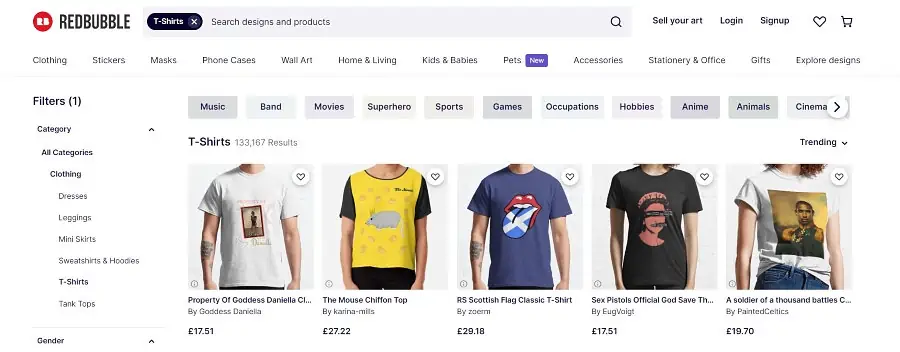
It’s an online marketplace offering a wide range of print-on-demand products, typically including t-shirts, stickers, tote bags, wall art, phone cases, and the like.
They take care of all the logistics, from printing and shipping to customer service.
It’s a place for talented artists and designers to sell their work, on different products, to customers all over the world. All without ever having to touch the goods!
In theory, this frees you to focus on your art and not have to worry about anything else.
You’re paid at the end of each month if you reach the minimum of $20 in sales.
It has a good organic reach on Google and actively promotes its merchandise (and designers) with Google shopping ads. With good keyword research and great designs, it is possible to earn money without marketing yourself further.
Why Artists Use Redbubble
The great thing about Redbubble is it allows independent artists, like you, to create an extra income. When you have your Redbubble shop set up, with all your tags and product descriptions written, you can begin to earn money.
Redbubble Takes Care of Everything
Redbubble takes care of all the printing and shipping for you, so you don’t have to worry about those logistics. Redbubble handles everything, all while you are sound asleep.
This is a great opportunity for beginners because if you don’t have any experience with running your own website, you’ll be overwhelmed with the workload, and probably give up.
Redbubble offers you freedom. Everything will be fine if you need to take a couple of weeks off or don’t have any new designs. You can go on holiday and forget about things and know your business will still be there when you return.
Instant Trust and Instant Traffic
When you work with a site like , you’ll have built-in trust with potential buyers, and that in turn, will result in more sales. They know that they can trust the returns policy and get a refund if they’re not satisfied. It gives a buyer confidence.
Trust is everything in business. If a customer doesn’t know you and your site, gaining trust is difficult.
When you sell on Redbubble, you don’t have to drive your own traffic. If you optimize your products properly, Redbubble will drive traffic your way. This will save you a lot of time.
Redbubble effectively does product research for you. It tells you everything you need to know. It tells you what sells best, it shows you current trends, and it provides the keywords and the data.
Relieved from all that stress, you’ll have more time to do the things you enjoy, namely creating art and having a social life.
It sounds too good to be true and that’s because it is.
Nothing is that easy.
Why Artists Don’t Use Redbubble
Your Designs Will Get Copied
On Redbubble, people are always on the lookout for the best-selling items, indeed that’s what everyone does to keep abreast of the latest fads and fashions.
Inevitably, bestselling designs get copied. There are rules about stealing but it’s easy to circumvent them. People simply make designs that are very similar.
Better read this: 15 Ways to Protect Your Artwork From Being Copied
Pretty soon, the market is swamped and there goes your profit. The lifespan of your designs is extremely short and so is the lifespan of your passive income.
That means you’ll have to make more designs to regain your missing income, and all of a sudden, you are racing to catch up with a system that will not allow you to win.
That’s not passive income at all.
Expect Low-Profit Margins
Another downside of using a third-party platform like Redbubble is that you must expect lower profit margins. Naturally, Redbubble takes the lion’s share. Why shouldn’t they? They have all the costs.
You can add your own markup, and set your own retail price, but you can’t charge much more than your competition. Lower prices are inevitable.
Think about it, Redbubble supplies a T-shirt, and it’s the same T-shirt no matter what design is printed on it. There’s no premium you can add that will convince Redbubble customers to pay substantially more. Even if your original designs are totally unique, your competitors will copy them in no time.
Inconsistent Quality Contol
That leads us to quality control. This is an issue. How do you know that your designs will be printed to a consistent standard? You don’t, because Redbubble outsources its printing to third-party printers, and that leads to variable standards.
The quality of the products matters. Even if you are not to blame, you don’t want returns and refunds to eat into your profits.
It Stifles Your Creativity
Another drawback when using this business model is how it limits your art and creativity. You might end up with an income, and wondering why you’re not making real art anymore.
The only way to earn money on Redbubble is to produce the designs that people are searching for, and that means doing keyword research and producing new work that fits the brief.
In other words, if you are not unashamedly commercial, you are wasting your time. If no one is searching for your unique, inspiring, thoughtful, and intelligent art, you won’t get found, and you won’t get a sale. End of.
Redbubble Buyers Are Not Your Customers
A customer, buying from Redbubble, is not buying from you. They are buying Redbubble’s products with your designs on them.
Redbubble retains all the customer’s information and contact details. it’s Redbubble who’ll retarget any offers or promotions, not you.
Anyone with retail experience will tell you that the real money is in the follow-up and repeat trade. Redbubble doesn’t allow you to brand your packaging or white label your goods. At the very least you need an email address, but you won’t get one.
You might expect that the customer will return to find your store, but one look at the competition and a viewer’s attention goes elsewhere.
A returning customer is not going to be loyal to your brand if there is no relationship. They are returning to Redbubble.
So, those are the pros and cons of using Redbubble, but you can’t make a judgment without knowing how the platform works. That’s what we’ll cover next.
Check out these posts:
- Is Udemy Worth it? Pros and Cons For Artists and Designers
- Is Skillshare Worth It? The Pros and Cons for Artists and Designers
- Is Selling on Etsy Worth it? Pros and Cons for Artists and Crafters
- Sell Art on Society6 Step-by-Step in 2023 (It’s FREE)
How Does Redbubble Work?
is a marketplace where artists can upload their designs and customers can purchase them on a variety of products. Artists earn a markup on each sale.
To get started as a seller on Redbubble, you must:
- Create an account on Redbubble and upload your artwork,
- Make a professional-looking profile with an interesting bio,
- Choose the items you wish to sell and add your designs,
- Add titles, product descriptions, and tags (keywords),
- Hit publish.
That’s the bare bones of it. It will take some time, and you’ll need plenty of designs, but you can get up and running very quickly. In theory, you can upload your first design and be making sales straight away, but it’s unlikely.
There are a few key things you can do to boost your chances:
- Regularly upload new designs and keep your stock fresh.
- Create enticing product descriptions that will draw buyers in.
- Use effective tags to help you target your sales.
- Keep an eye on the competition and learn from their successes and failures.
A customer can browse Redbubble for designs they like (which will be yours naturally) and then buy them on the site.
Redbubble prints your art from one of 32 locations worldwide and ships them directly to the customer. Job done. Your account is then credited with your profit.
After your initial input, this is as passive as you want to make it. Your main job is to upload great designs and imagery as high-resolution files. Redbubble takes care of the rest.
If there is an expense for an artist, it’s getting their art scanned. Digital artists are at an advantage in this regard. (Update 2023 – standard plans pay a fee)
A print is only as good as the file it is printing from. This is the bottom line.
Redbubble permits Hi-Res Jpg, GIFF, and PNG files. Preferably the latter. PNG files allow transparent backgrounds and are ideal for printing designs onto fabric. (source)
Redbubble also advises saving your master files in CMYK color format.
To gain the most out of Redbubble your file resolution must be high enough to print on any product. Redbubble states that the best option is 7632 x 6480 pixels will be optimal. This size allows printing on a king-size duvet cover.
I looked at the wall art section to check out size requirements for art prints and the only exception was for extra-large photographic prints that require 9144 x 6096 pixels.
If that means getting a good home scanner (Epson Perfection V600) or outsourcing the job to your local printer, so be it. You can take your own photos, but you must know what you’re doing. Borrow a good camera if you have to.
How to Get Found on Redbubble
You will be able to make some sales through organic searches alone but to optimize your reach you are advised to promote your work.
In order for Redbubble to promote you in search engines, it has to be told exactly what you selling, who the audience is, and the words and phrases they would use to try and find them.
Titles and descriptions are the first things people see when they find your product, so it’s important to make them count. Don’t waste your keywords with fluff. Be direct. Your title must tell Redbubble, and your customer precisely what you’re selling.
Including relevant tags will help your designs show up in search results, so be sure to use keywords that describe your product and use the words and phrases your customers would use. You can add up to a maximum of 50 tags per item. Use them all.
The description must be written in natural English. It should be positive, and upbeat. Describe your product, with a degree of hyperbole, to encourage the sale. Don’t forget to sprinkle in more keywords.
Add Your Designs to a Wide Variety of Redbubble Products
Add images to as many products as you can, it will take a long time, and it’s hard work, but there is a good reason to do it.
Every time you post a new image it gets indexed on Google and potentially shows up in the search results. If you have a lot of products, with descriptions and keywords, you will maximize your chances of being discovered.
Redbubble has a wide variety of products that you can customize. In fact, they have too many, so choose the products that you’re most interested in and which complement your design.
When creating a design, keep it simple. The simpler the design, the more popular it will be. If you create a complex design, it will not have the same impact on a small screen.
How to Add Keyword Tags Effectively on Redbubble
One of the most important and best things artists can do on Redbubble is to add relevant keyword tags to their designs, as this allows them to appear in more search results.
When adding tags, it’s important to be as specific as possible, as this will help you to target the widest range of potential customers and get in front of the right people.
- Name your products clearly and unambiguously.
- Use creative and descriptive adjectives to describe the style of the item.
- Target your audience directly. For example, if something is for kids, say so.
Don’t leave everything to guesswork and intuition. You’ll need to do some keyword research.
Here’s how you can do it yourself
Redbubble Search
Enter your keyword in the search box and the results will show your competitors ranking for that word or phrase. Take a look at their tags and note the ones you’re not using.
If you scroll to the bottom of the page you will see ‘Related Searches’ with more keywords. Use them.
Alphabet Soup Method
Go to Google and enter one of your keywords into the search bar. A dropdown menu will appear with predictions of your search intent. These are the most likely words you will type next according to popularity.
There will be plenty of new keywords you hadn’t thought about.
Then go through the alphabet by adding an ‘a’ after your keyword, then a ‘b’, and so on. You will find many new tags.
Look under ‘People also ask’ and ‘Related searches’ for more ideas.
Keyword Research Tools
Good keyword research tools are extortionate. The best tool, by reputation, is Ahrefs, which will set you back about $100/m. But you can go on Fiverr and get someone to search on your behalf and send you a report.
A basic job that will take someone on Fiverr a few minutes, and cost you $5-ish.

I have paid for a keyword tool called. It’s good enough for this type of research.
I entered Redbubble.com in the ‘Domain’ search box and a list of their best-performing keywords is listed.
Below is a screenshot and I found a goody (now out of date).

Look at the top keyword ‘cool tshirt.’ Serpstat says it ranks organically at position number 1 on Google.
Now, look at the keyword difficulty, it says ‘0’. That means there is next to no competition for that keyword term.
Now, look at the volume and traffic. There are many thousands of searches for this keyword. That’s all you need to know
The numbers are not gospel, the numbers are well-informed guesswork. Only Google knows the real figures. The best keyword tools have more accurate statistics and that’s what you’re paying for.
Now we can check if Google finds any volume for the phrase. We can’t find the volume but we can see if it’s a popular search term. I entered ‘cool tshirts’ and the screenshot below is the result.

Wow, it shows full data, which means 10s of thousands of people are searching this term, all from English-speaking first-world nations. That’s great.
Now the big reveal, let’s look at Google and search for ‘cool tshirts’ and see if Serpstat is right.
What do you know? Here on page one, underneath the Google shop paid ads, are 6 Redbubble T-shirts using our keywords.
If your listings were optimized for ‘cool tshirts’ exactly as it is spelled, you have a high chance of appearing at the top of the first page.
Not only that, a keyword score of ‘0’ means it is well within reach for anyone to rank for this term.
It’s a good idea to write a blog post. You don’t need a website, you can join Medium instead. It’s a huge blogging platform with instant authority and your content will rank quickly.
Write about your products and sprinkle ‘Cool tshirts’ liberally throughout your article. Add images and links back to your Redbubble store. You should appear on the first page of Google for your low-competition keyword plus your Redbubble page will get a boost too.
If you have your own website, write a post about your “Cool t-shirts” there too, and link your medium article to your blog post.
You could have 3 websites all promoting your product on page one. What about that?
The Best Ways to Sell on Redbubble
The key to gaining sales on Redbubble is to know your audience and design the things they’re actually searching for and design your products accordingly.
The most successful designers keep up with trending topics and are adaptable enough to design new images to cash in.
Look at popular designs, don’t copy them, but use them as inspiration and as a guide to what is selling. You are unlikely to out-compete the top sellers, but if you can find underserved niche products or base your designs around a theme with proven results, you can leverage sales.
It’s worth mentioning that you will not be alone in this tactic. As soon as a design becomes a bestseller, the market gets saturated with look-a-likes.
You can stand out if you have a distinctive style of your own and if you are willing to bend to the needs of your audience.
How to Make Extra Money on Redbubble
Redbubble sets the default seller’s margin at 20%, but this is flexible, you can set a higher profit margin if you wish.
In my selling experience, there’s no point in trying to undercut anyone.
As a business friend told me years ago, he prices up to his competitors, not beneath them. He sees what his competitors are selling, and how much they charge, then matches the price. Why compete? Everyone loses.
When people see something they like, and it’s in the right price bracket, they’ll buy it anyway.
It’s sound advice.
Small ticket items can have higher margins. Don’t concern yourself too much with percentages. It doesn’t mean much. The only thing that matters is your actual profit, in cash terms.
A small percentage of an expensive item will still be worth more than a huge markup on a cheap item.
When it comes to pricing you must experiment. When you get sales, you can edge your prices up until you hit a sweet spot. Stop when your sales dip.
You can be an affiliate for Redbubble. Read this: 45 Affiliate Programs for Artists: Mega Guide
Update: Redbubble’s New Fees Could Cost You 50% of Your Art Sales
For years, Redbubble has been a go-to platform for independent artists, offering a low-risk, operationally simple way to earn passive income. The model was straightforward: upload your art, and Redbubble would handle the production, shipping, and customer service, sending you a check for your cut.
However, recent and significant changes to Redbubble’s fee structure have fundamentally altered the platform’s value proposition. A new, complex system of account tiers and fees has been introduced, creating major financial hurdles, especially for new and lower-volume creators. Understanding these surprising new rules is now critical to determining if the platform is still worth your time and creative energy.
Here are the four most impactful and counter-intuitive takeaways from Redbubble’s new model that every creator needs to know.
Takeaway 1: The “Standard Tier Trap” Can Claim 50% of Your Earnings
The biggest change is a new 50% platform fee for artists in the “Redbubble Standard” tier. This entry-level tier applies to most new sellers and those with lower sales activity. If your account is classified as Standard, half of your monthly earnings will be deducted by the platform before you see a dime.
This fee acts as a powerful “profitability filter” designed to make high-volume, low-quality uploads financially unsustainable. For established artists, it’s a nuisance; for new artists, this fee turns Redbubble from a simple income stream into a costly testing ground where significant effort is required just to break even.
The primary strategic goal for any new artist on the platform must now be to meet the criteria to get promoted out of this punitive tier as quickly as possible.
Redbubble is explicitly using this fee to filter out high-volume, low-quality sellers (“spam”) by making their endeavor financially unsustainable.
Strategic Implication: Your first 90 days on the platform should be treated as a probationary period. Focus intensely on creating a small portfolio of high-quality, commercially viable designs to escape the 50% fee, rather than uploading a high volume of untested work.
Takeaway 2: You’re Now Penalized for Pricing Your Art “Too High”
In a move that limits artist pricing power, Redbubble has introduced an Excess Markup Fee. Artists are now charged a 50% fee on earnings generated from a product markup that is set above 20%.
The nature of this rule is deeply counter-intuitive. While Redbubble’s marketing claims artists have “full control over your pricing,” this fee effectively punishes creators for charging a premium and creates a hard price ceiling. If you believe your art has a higher value and set a 30% markup, Redbubble will deduct a 50% fee from the portion of your margin that comes from the extra 10%. To maximize your realized profit, the new optimal pricing strategy is to set your product markups at or below the 20% threshold to avoid the penalty.
Strategic Implication: The 20% markup is not a suggestion; it is the new practical ceiling for maximizing profit. Price all new products at this level to avoid automatic profit reduction.
Takeaway 3: “Passive Income” Now Requires a Very Active Escape Plan
The promise of passive income on Redbubble is now a distant goal, requiring active and dedicated effort. Even for artists who achieve the 20%-fee Premium tier, the climb to profitability is steep.
Redbubble is explicit about the criteria it uses for tier advancement, rewarding artists who positively engage with the marketplace. To move up, you must demonstrate:
• Design quality and artistic skill level
• Volume of designs
• Account activity
• Commercial success
• Adherence to Community and Content Guidelines
A Reddit case study grounds this reality in hard numbers. One creator with a Premium account reported uploading 402 unique designs over six months, a rate of more than two per day, and earned only $191.
This is an alarming insight: even after an artist has proven their quality and been promoted out of the Standard tier, the path to significant income remains incredibly arduous. This underscores that immense, consistent effort is now required for even minimal returns, making the “passive” label a distant goal.
Strategic Implication: Even achieving Premium status is not a guarantee of significant income. Success on Redbubble requires a long-term strategy of high-volume, high-quality, niche-focused uploads, not just a short sprint to escape the Standard tier.
Takeaway 4: Your Biggest Rival Isn’t Competition—It’s Your Own Stolen Art
A persistent and growing challenge on Redbubble is rampant intellectual property (IP) infringement. Because it’s an open marketplace with a massive volume of user-generated content, the platform has become a major hub for stolen designs.
For successful artists, this creates an ongoing “whack-a-mole” scenario. They must constantly monitor the site for copycats and spend valuable time filing official takedown requests to protect their work.
This reality diminishes the “passive” nature of the platform, as creators must dedicate active time and resources to IP enforcement just to defend the sales they’ve rightfully earned.
Despite its mission to support artists, Redbubble has become a hotspot for copyright and trademark violations.
Strategic Implication: Factor in time for IP monitoring as a regular operational cost. The “passive” income promise is only realized if you actively defend your portfolio from infringement.
Conclusion: A New Redbubble for a New Kind of Creator
Redbubble is no longer a universal, passive income engine for all creators.
Redbubble has strategically repositioned itself as a high-stakes proving ground that heavily favors and rewards commercially successful, high-quality, and actively engaged artists specifically, those who can successfully escape the punitive entry-level tier.
For creators who can meet these demanding criteria, it remains a powerful tool. For everyone else, it has become a much tougher and more expensive place to do business.
Given these new realities, is Redbubble a proving ground for your best work, or a trap for your creative energy?
There is more than one way to make a living. I’ve been trading my art prints for over 20 years from a market pitch. You Can too.

If you found this article useful, check these out too:
- Is Domestika Worth It? The Pros and Cons for Artists and Designers
- This is How Artists Make Passive Income
- Is Printful Worth it? Print on Demand Review (2023)
- How to Make Money With Digital Art: 10 Ways to Profit
- 25 Platforms for Artists to Sell Their Art Online and Make Money
- 19 Ways to Make Money as an Artist Online and Off: No Fluff!
- Is Selling Art on eBay Worth it? Pros and Cons (2023)
- Is Patreon Worth it? What You Should Know in 2023
- Social Media For Artists: The Best 13 Platforms for Creatives
- Where to Print Art Prints From Etsy (Downloads / Printables)
- Are Online Drawing Courses Worth it? I Chose 5 of The Best For You!
PIN THIS


Hi, I’m Kevin Hayler
I’ve been selling my wildlife art and traveling the world for over 20 years, and if that sounds too good to be true, I’ve done it all without social media, art school, or galleries!
I can show you how to do it. You’ll find a wealth of info on my site, about selling art, drawing tips, lifestyle, reviews, travel, my portfolio, and more. Enjoy