

Learning to draw as a beginner is simpler than most people think. They over complicate things.
Most beginners struggle because they try to learn everything at once. They buy the fancy kit, far more than they need, and expect to see results.
It doesn’t work like that. That’s the way to get frustrated and quit.
Drawing gets easier when you break it into small, manageable steps. It’s like constructing a model. You start with the frame and build, one step at a time.
This guide shows you how to do exactly that. You will learn what actually matters, what to ignore for now, and how to start drawing with more confidence.
Disclaimer: When you buy something via my affiliate links I earn from qualifying purchases and sometimes earn a commission, at no extra cost to you. I am an Amazon Associate among others. I only recommend trusted sites.
What You’ll Learn In This Guide
This guide walks you through drawing in a logical order. It’s written for complete beginners who want clear direction.
You’ll start with the drawing supplies that matter. I’ll explain what each tool does, why it’s useful, and what you can safely skip when you’re starting out.
The aim is to help you spend less money and make better choices.
From there, you’ll learn how artists break everything down into simple shapes. This is one of the biggest mindset shifts beginners need to make. Once you stop drawing what you think you know and start drawing simple shapes, everything becomes easier to draw.
You’ll also learn how value works, meaning light, midtones, and darks. This is what gives drawings depth and makes them look solid instead of flat. I’ll explain how to practice this with simple exercises so your shading improves faster.
Lastly, you’ll be introduced to the most useful drawing techniques. These are the techniques you’ll see artists use again and again. You don’t need to master them all at once, but you do need to understand how and when to use each one.
Choosing Your Drawing Supplies
You only need a small setup to get going. A few graphite pencils, decent paper, an eraser, and a sharpener are enough. Anything beyond that is optional. Starting simple lets you focus on learning how to draw instead of learning how to use lots of tools.
Graphite pencils come in different grades. Softer ‘B’ pencils make darker marks and ‘H’ pencils are harder and make lighter lines. Using a small range of grades gives you flexibility, you will probably select half a dozen favorites, ranging somewhere from 3B – 4H for most people.
To get a comprehensive guide read this: What Do Pencil Numbers Mean? Pencil Grades Explained
Drawing paper matters too, but it doesn’t need to be fancy. Smooth cartridge drawing paper or a cheap basic sketchbook works well for practice. What matters most is that you feel comfortable using it and you don’t worry about “ruining” pages.
For a complete guide read this: What is The Best Paper for Graphite Pencil Drawing?
A kneaded eraser lets you lift graphite gently without damaging the paper. Remember that an eraser is not just for repairing mistakes, it’s a drawing tool in it’s own right. Think of it as a negative pencil.
Read this one too: 9 Best Erasers for Drawing: Eraser Types for Artists
You maybe tempted to buy complete sets at first, and that’s fine, if it allows you to find the best kit that works for you, but please take note, that you must buy well known branded drawing materials.
I’ll tell you why.
All the major companies have reliable products and the quality is consistent. Pencils, drawing paper and erasers will perform exactly the same way, every time you buy and use them. This is super important.
Choose a brand and stick with them. I use Derwent pencils, it’s not that they are better than Faber or Staedtler, it’s because I can buy individual pencil replacements, and I know the grading system.
A beginner should never mix and match brands. An HB pencil in Faber is not the same grade as an HB in Derwent. Each company uses a different scale.
Most sites don’t tell you this.

If you like the way I draw and want to try things for yourself, this is my basic kit

Understanding Basic Shapes
One of the biggest mistakes beginners make is trying to draw what they think they see. The moment you label something as an eye, a tree, or an animal, your brain jumps ahead and fills in symbols instead of what’s actually there.
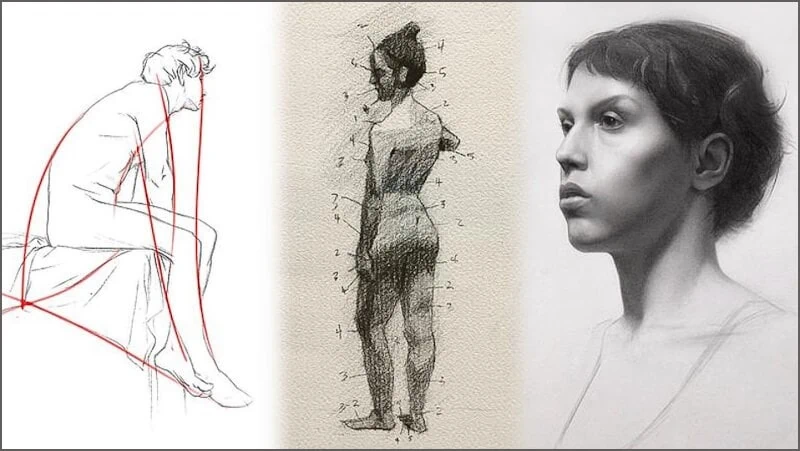
Learning to draw starts with learning to see shapes. Every subject, no matter how complex, can be broken down into simple forms like circles, rectangles, cylinders, and triangles. These shapes give you structure and keep your drawings from drifting out of control.
Start by looking at your reference and blocking in the largest shapes first. Don’t worry about details at this stage. You’re setting up the overall size, position, and balance of the drawing.
Once the big shapes are in place, you can break them down into smaller shapes. This is where the drawing begins to take form. Keep checking relationships between shapes, like height versus width, and where things line up.
Details come last.
If the shapes are wrong, details won’t save the drawing. When the shapes are solid, details feel much easier and more natural to add.
Getting To Know Values
Along with shapes, value is one of the most important things you can learn as a beginner. Value is simply how light or dark something is. It’s what turns flat shapes into forms that feel solid.
If everything in your drawing sits in the same mid-gray range, it will look flat and dull. When you use a full range of light, medium, and dark values, your drawing starts to have depth and weight.
Read this for a comprehensive guide: How to Create Depth in Your Drawing: 7 Pro Tips
A good way to train your eye is by making simple value scales. This means shading from very light to very dark using one pencil. It teaches you how much pressure to use and how many different tones you can actually create.
Light values usually describe highlights and areas hit directly by light. Midtones describe surfaces that turn away slightly from the light. Dark values describe shadows and areas that receive very little light. Once you understand this, shading becomes far less confusing.
recognizing where the light source is coming from is the key to convincing shading.
Read this post for help: How to Draw Realistic Shadows in Pencil: Light and Shade
Spend time practicing values on their own. It’s one of the fastest ways to improve your drawings, and it carries over into everything you draw later on.

Not sure where to start? Try this course
Basic Drawing Techniques
Once you understand shapes and values, you need ways to put them on paper. That’s where drawing techniques come in. These are simply different ways of moving the pencil to build tone and texture.
Hatching uses parallel lines to build shading, usually diagonals. The closer the lines are, the darker the area looks. It’s controlled and easy to adjust, which makes it useful for beginners. Do not be tempted to stray from following the direction of the lines you set.
Cross hatching builds on that idea by layering lines in opposite directions. This lets you push darker values and add texture without pressing harder on the pencil. Use parallel lines in reverse. NOT random angles.
Pressure Shading. This technique comes with a warning, if done to excess, soft pencils will leave pencil shine, and hard pencils will damage the paper. If practiced gently, light pressure gives you pale tones, heavier pressure gives you darker tones. This technique is useful when you want softer transitions.
Read this: 9 Ways to Stop Pencil Shine in a Drawing and Save Your Work!
Stippling uses dots instead of lines. The more dots you add, the darker the area becomes. It takes patience, but it’s a good way to slow down and think about value. This is not a technique I use myself, but it is very handy if you use ink pens.
Line Width plays a bigger role than most beginners realize. Thin, light lines suggest lighter areas and distant form. Thicker, darker lines suggest weight, shadow, and depth. You can change line width by adjusting pressure, drawing angle or switching pencil grades.
Most tutorials suggest scribbling or scumbling as a technique. I include it here to advise against using this method. It almost never creates good results, certainly not for beginners. In fact it’s screams amateur. Don’t do this until you are super confident.
As always, it’s all about practice. Over time, you’ll start switching between these techniques and use them without thinking.
Additional Skills Worth Learning
At this point, you can already start drawing and improving through practice. But there are a few extra skills that will make a big difference once you’re comfortable with the basics.
These aren’t things you need to master straight away. Think of them as awareness skills. The more you understand them, the fewer problems you’ll run into later.
Composition affects how the eye moves around your drawing. Simple planning before you start helps avoid awkward layouts and empty areas.
Use this guide: How to Plan and Compose Your Art: A Beginners Guide
Proportions are about relationships. When sizes and distances are off, drawings look wrong even if you can’t explain why. Learning to measure and compare shapes helps fix this early.
You can work on all of these slowly over time. Just knowing they matter puts you ahead of most beginners.
If you need more help with drawing, then I urge you to check out
Dorian Iten on Proko. His course is reasonably priced and inspiring
Learn to Draw for Beginners: Final Thoughts
Don’t wait until you feel ready to start drawing. The right time never comes. Practice a little, then practice some more. Progress comes from repetition and small wins. Pick up a pencil, accept that early drawings will be rough and learn by your mistakes. That’s how every artist starts.
If you found this guide helpful you might like to check out these articles too:
- 7 Types of Contour Drawing Explained: Quick and Easy
- 32 Drawing Mistakes and Bad Habits Artists Must Avoid
- How to Know When Your Drawing is Finished: Don’t Ruin it!
- Best Easel For Drawing and Painting: How to Choose
- Can Adults Learn to Draw? Is it Too Late to Start Drawing?
- Is Drawing a Grid Cheating? Do Real Artists Use Grids?
- 4 Ways to Draw White Lines in a Pencil Drawing: Do This…
- How to Draw Water in Pencil: Step By Step
PIN THIS


Hi, I’m Kevin Hayler
I’ve been selling my wildlife art and traveling the world for over 20 years, and if that sounds too good to be true, I’ve done it all without social media, art school, or galleries!
I can show you how to do it. You’ll find a wealth of info on my site, about selling art, drawing tips, lifestyle, reviews, travel, my portfolio, and more. Enjoy